Services

Senior judgement, applied where your software hurts most.

Three focused offers. Each names who it is for, how the work runs, and what the system looks like when it is done.

Larger engagements are delivered with a network of vetted senior developers. Every crucial decision and the quality bar stay with the architect you speak to.

01

AI-Driven Process Automation

Who it’s for: SMEs overwhelmed by manual processes — support inboxes, order handling, reporting, legacy data.

How it runs: an AI Discovery Workshop to find the one workflow worth automating, then a 4-week pilot built on LangGraph or Google ADK, evaluated before it touches production.

“Pick one pain point, execute well.”
— Aditya Challapally, lead author of MIT’s “The GenAI Divide”. The AI Discovery Workshop exists to find that one pain point.

Source: MIT Project NANDA, “The GenAI Divide: State of AI in Business 2025”, reported by Fortune.
Book an AI Discovery WorkshopNot sure you’re ready? Take the 10-minute AI Readiness Checklist →
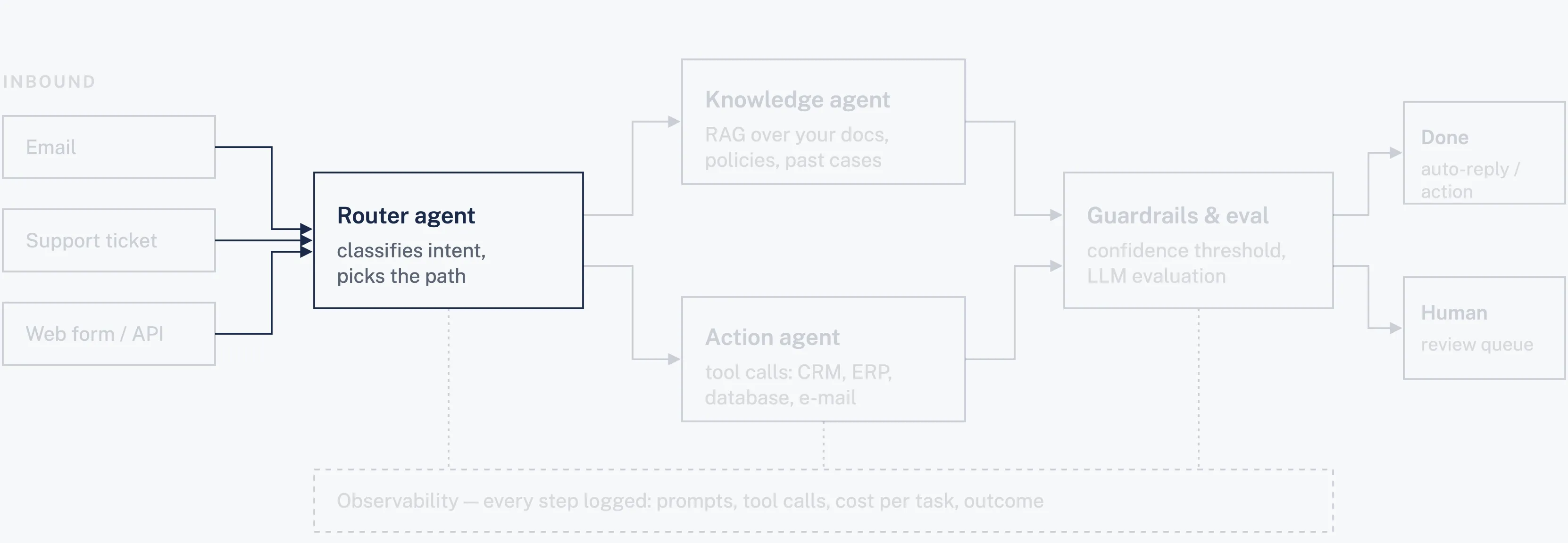
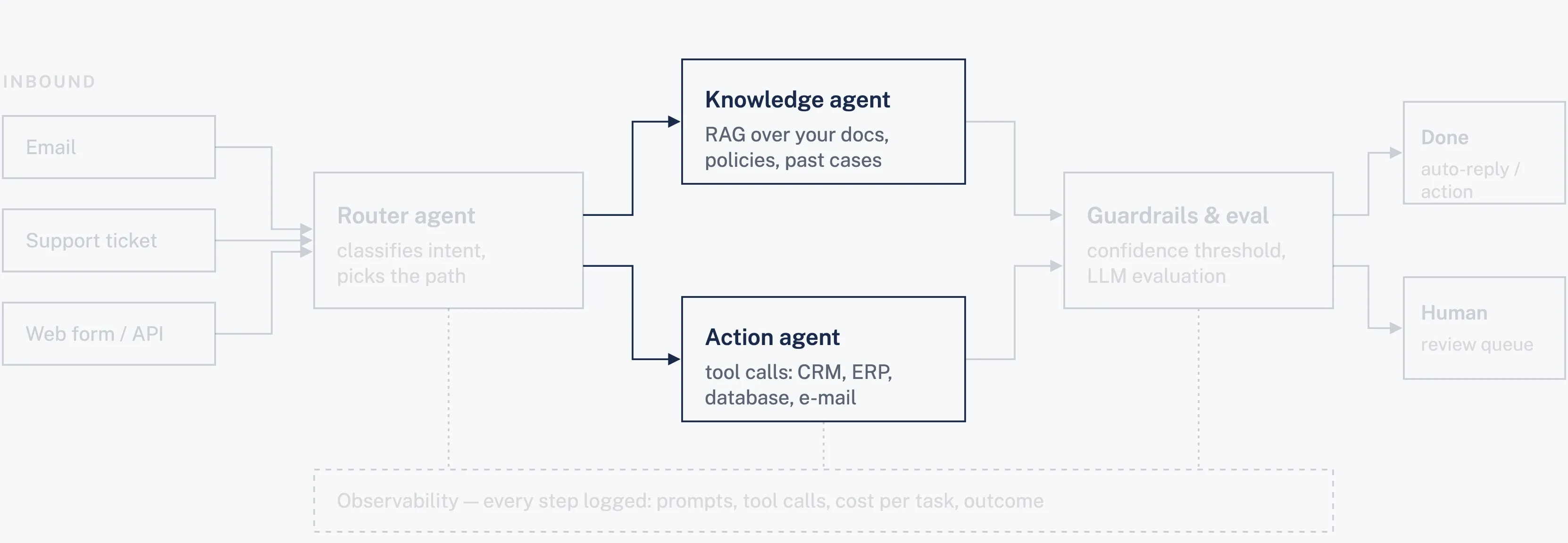
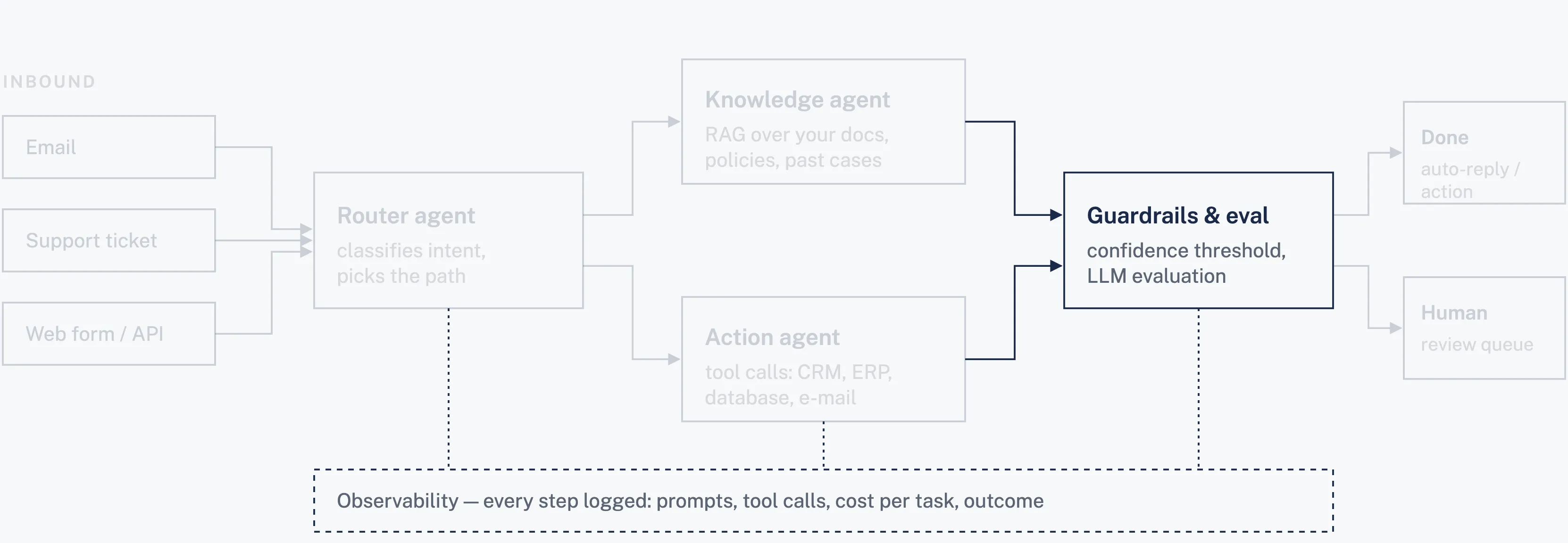
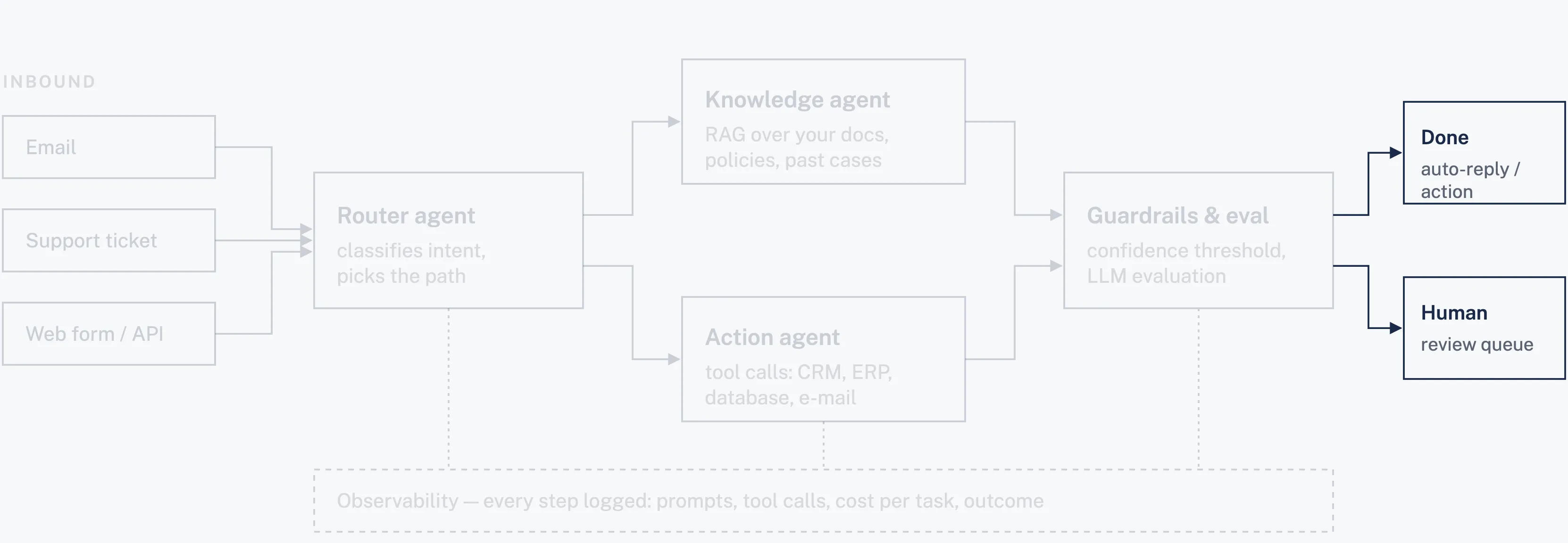
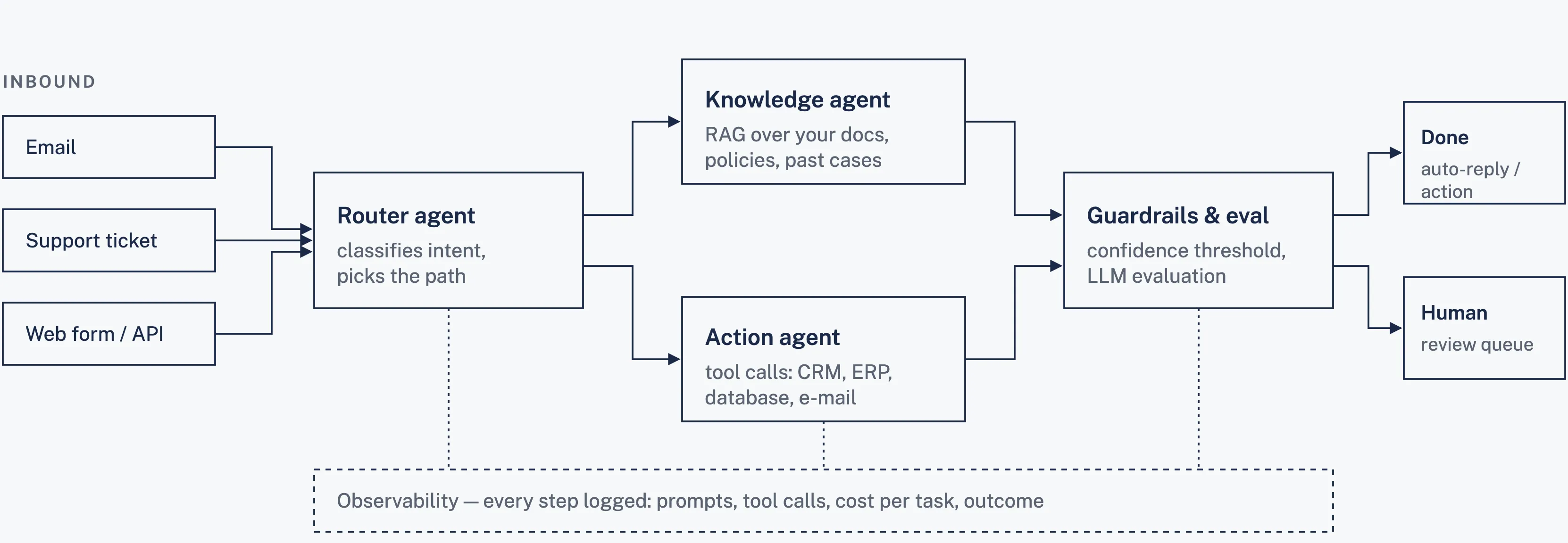
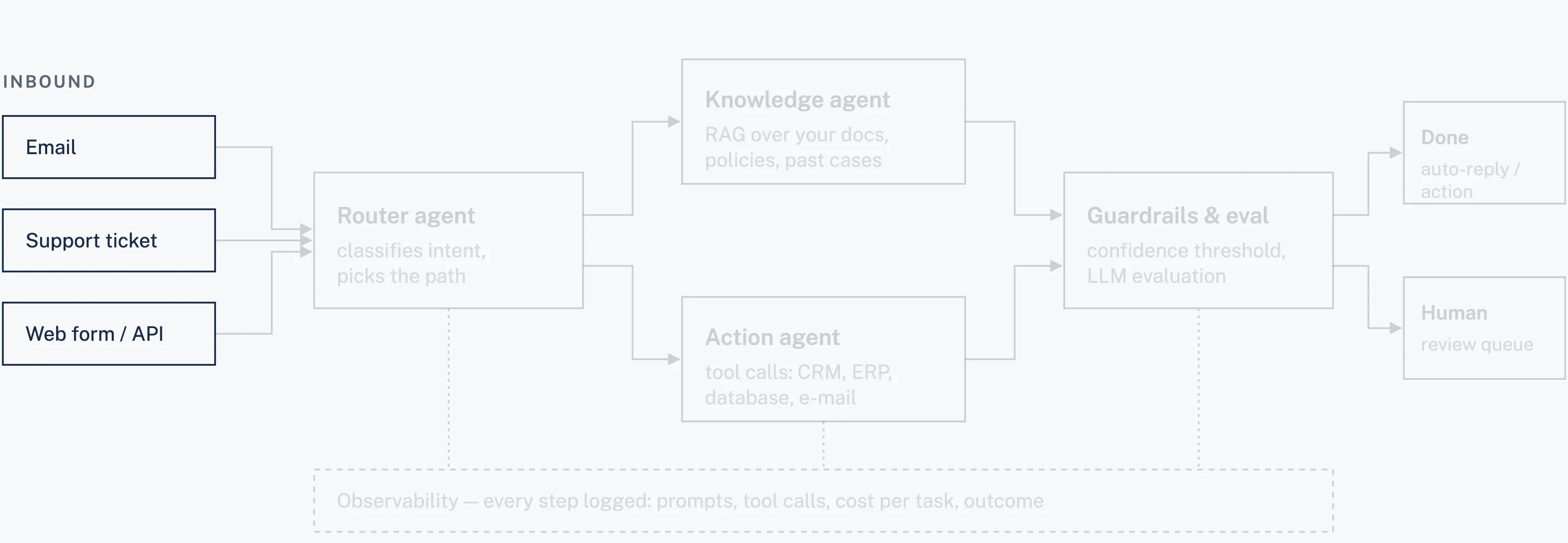
AI agent orchestration: inbound requests go to a router agent, which delegates to a knowledge agent or an action agent; results pass guardrails and evaluation, then either complete automatically or go to a human review queue. Everything is logged.
Typical pilot shape.
  1. Requests arrive as they do today

    Email, support tickets, web forms and APIs stay as they are. Nothing changes for the people sending them.

  2. A router agent reads each one

    It works out what the request is asking for and picks the path.

  3. Knowledge or action

    Answers come from your own documents and past cases. Actions go through your CRM, ERP or database.

  4. Checked, and logged

    Every result is scored against a confidence threshold and evaluated. Every step is logged, with its cost.

  5. Done — or a person decides

    Confident results complete on their own. Everything else goes to a human review queue, which is what makes a 4-week pilot safe to put in front of real customers.

02

MVP-to-Scale Transformation

Who it’s for: funded startups and SMEs whose technical debt now blocks growth.

How it runs: a short architecture review to find what breaks first, then refactoring, AWS migration and tuning in stages, with the system live throughout.

What changes: reduced operating costs, stable availability, and a release cycle measured in days, not weeks.

Talk about your MVP
Maciej Rogosz on a phone call at his laptop
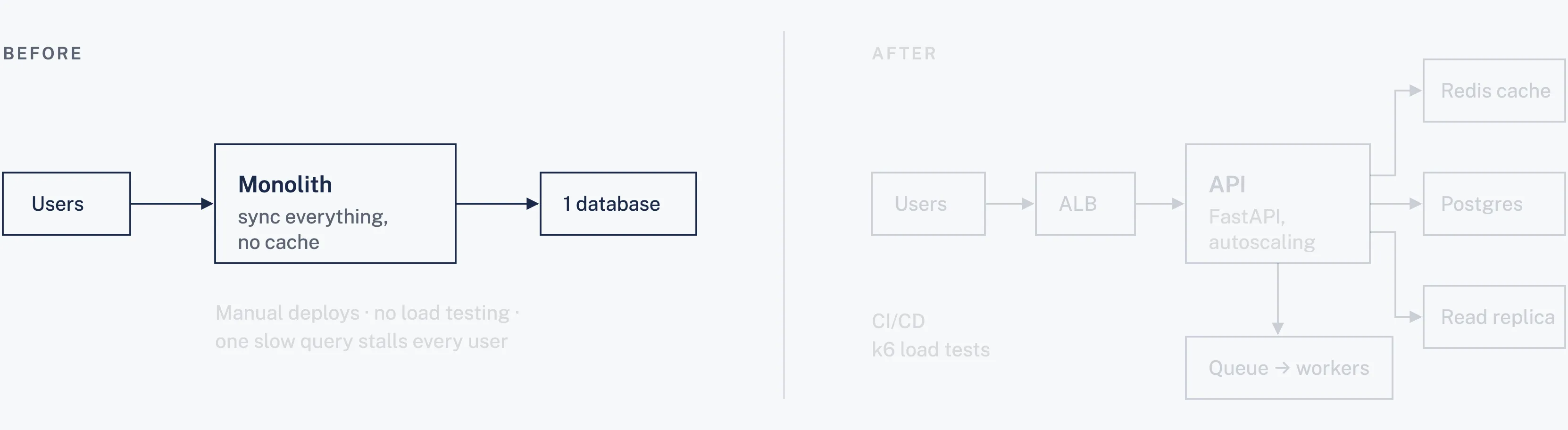
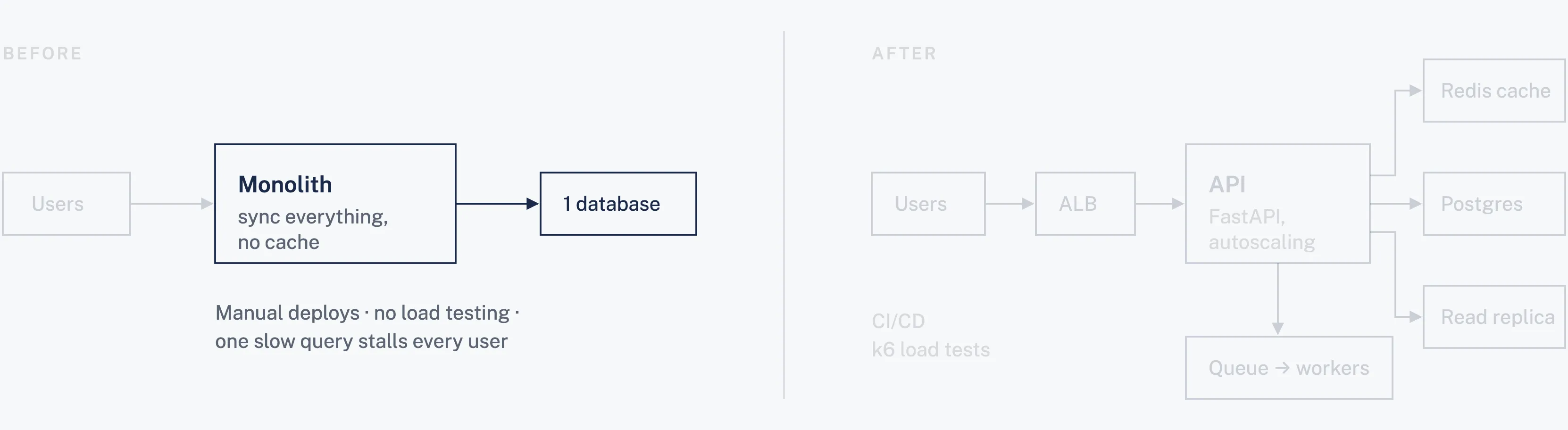
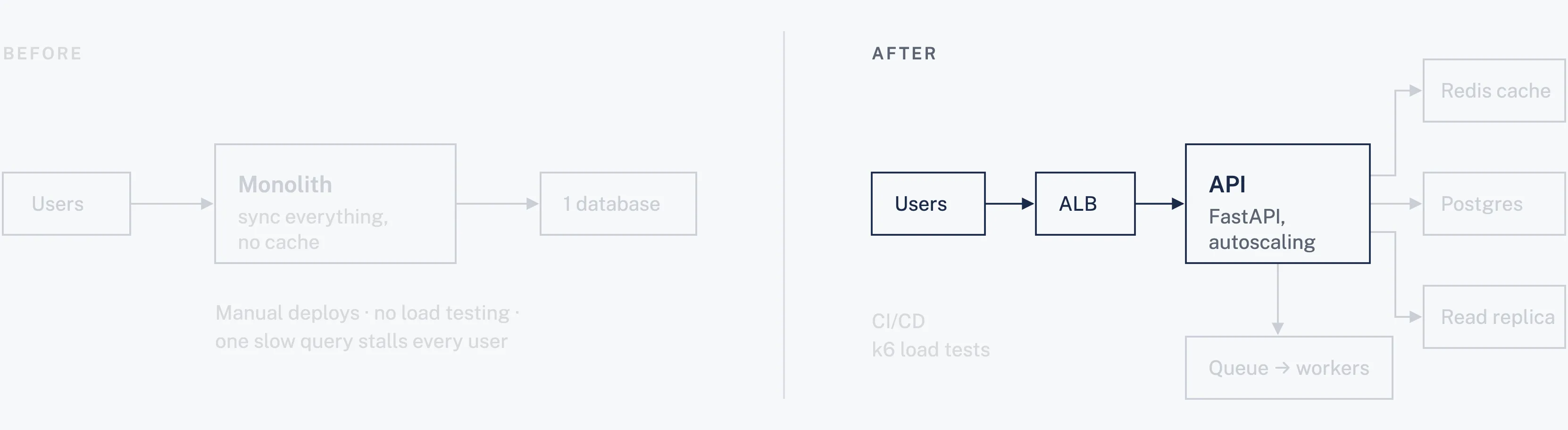
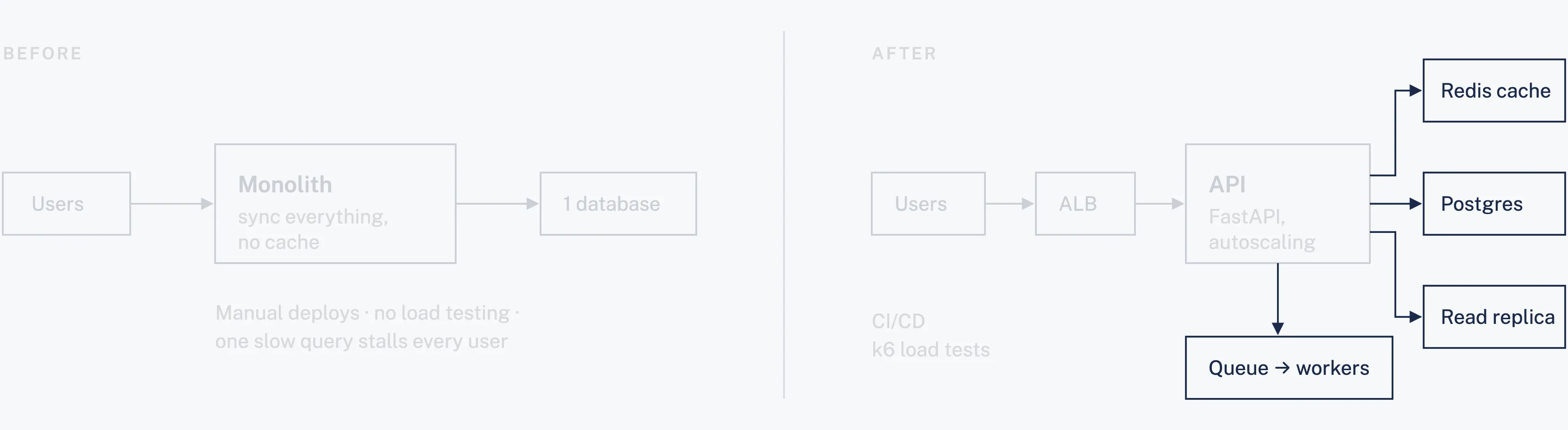
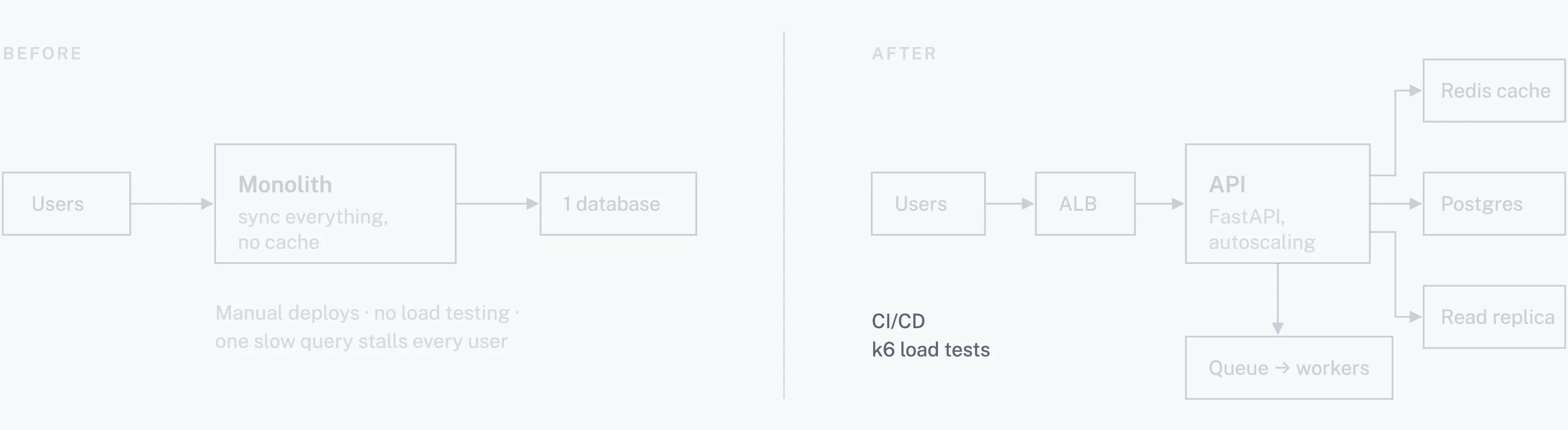
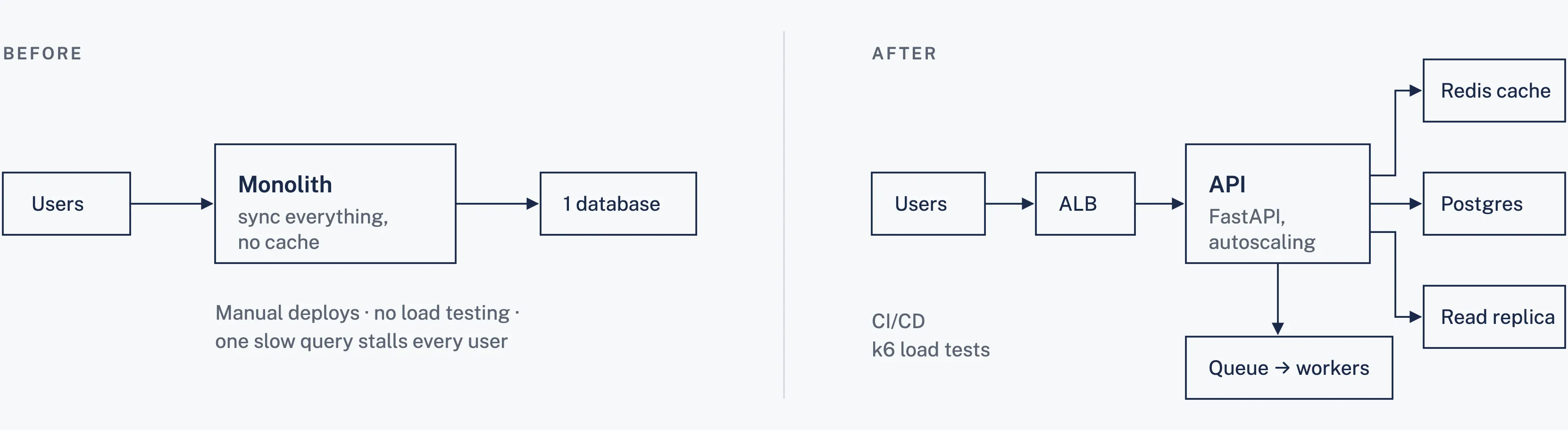
Before: users hit a single synchronous monolith with one database and manual deploys. After: traffic goes through a load balancer to an autoscaling API with a Redis cache, a queue feeding background workers, and a Postgres primary with a read replica, all deployed by CI/CD.
The usual starting point, and where it ends up on AWS. Each engagement adapts this to the real system.
  1. Where most MVPs start

    One synchronous application and one database, with everything in the request path.

  2. Where it breaks

    Deploys are manual, nothing is load-tested, and one slow query stalls every user at once.

  3. Traffic, spread out

    A load balancer in front of an API that scales with demand.

  4. Slow work, off the request path

    A cache for hot reads, a read replica for reporting, and a queue so heavy jobs run in the background.

  5. Guarded on every release

    CI/CD ships every change, and k6 load tests show it holds before your customers find out.

03

Full-Stack Product Development

Who it’s for: founders who need a product built end-to-end on Python, React and AWS.

Budget control: an hourly rate plus fixed-price components, so the scope you can predict is priced up front.

Scope your product
Maciej Rogosz on a sofa with a tablet, a laptop on the table
Delivery pipeline: discovery, architecture and estimate, build in sprints, CI/CD with load testing, launch, then handover with documentation.
How a build runs, from first call to handover.
  1. Discovery

    What the product has to do, for whom, and what could sink it.

  2. Architecture

    A design and an estimate before any code, so the fixed-price parts are priced up front.

  3. Build

    Short sprints, each ending in a demo you can click through.

  4. CI/CD and load tests

    Automated deploys and k6 load tests from the first sprint, not bolted on before launch.

  5. Launch

    Released on AWS.

  6. Handover

    Documentation, and your team walked through the system, so it does not depend on us.

Not sure which one fits?

That is what the first call is for. Thirty minutes, and you leave with a clear next step either way.

Book a 30-min discovery call
Book a call