Own product · General aviation
GA Mate: founded, architected and built end-to-end
A complete platform owned by one architect, from data model to deployment.
The problem
GA Mate is RogoszIT’s own product, so the problem did not arrive in a brief. It came from a plain observation about general aviation: one flight matters to several people, and each of them needs something different from it. The pilot needs an aircraft at a given time. Whoever runs the fleet has to approve that without double-booking anything. Someone has to know when the aircraft is next due for service, and someone has to invoice for the hours.
Those are four views of one event. Keep them apart and the same flight gets written down again and again, and the copies drift. The question worth answering was whether one architect, working alongside full-time engagement work, could take a single account of that flight from a blank page to something real people would try.
This study differs from the others on this page. There is no client to anonymise and no team to share credit with. What it demonstrates is scope: every decision, every layer, one person.
The approach
The data model came first, because in a domain with real-world rules the model is the product. Get it wrong and every screen above it inherits the mistake. The back end had been under way for six months before the interface got its first commit.
The model follows the flight through its life. A pilot requests a booking, and a flight log is created alongside it. When the organisation accepts the booking, the system checks that aircraft for overlapping bookings, then moves the booking and its flight log to the next status together, so the two cannot tell different stories. After the flight, the log holds what happened: times, crew, landings, hobbs and tacho readings. From there it moves on through invoiced and paid.
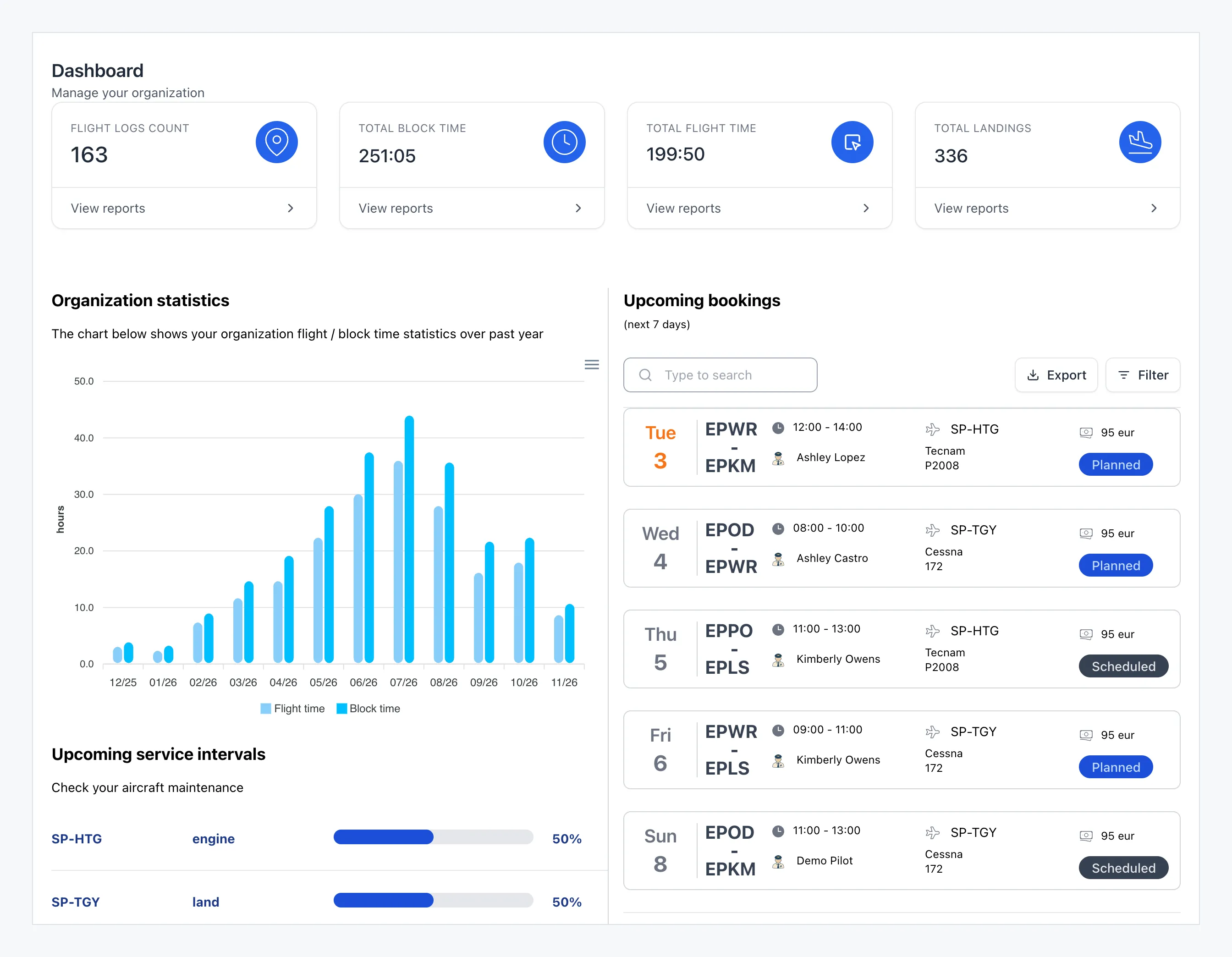
Recording the flight is what updates everything else. Aircraft maintenance falls due by usage, so each service interval tracks the measure it depends on — hobbs, tacho, flight time or block time — and updating the flight log advances those counters in the background. The dashboard’s flight totals and monthly hours are computed from the same logs. Nobody re-enters anything.
Aviation organisations also have people in distinct roles, and pilots can belong to more than one organisation. So permissions are scoped per organisation: what you may do depends on your role in the one you are acting for.
The system is deliberately plain to run. It is a modular monolith in Python and FastAPI, with separate modules for aircraft, bookings, flight logs, maintenance and organisations, in one deployable service. PostgreSQL holds the records. Redis holds sessions and acts as the broker for Celery, which does the background work. The front end is React and TypeScript on Next.js. Packaging is Docker and delivery runs through CircleCI, so shipping was a pipeline rather than a thing to set up later.
The unglamorous parts were in scope from the start. There are around 500 automated tests, with more test code than application code, which is not what a solo, part-time build usually looks like.
Throughout, the build stayed open to feedback from general-aviation stakeholders while the architectural decisions stayed in one pair of hands. That is the arrangement RogoszIT argues for on client work, tested here on its own product: wide input, singular ownership of the decisions that are expensive to reverse.
The result
GA Mate reached a functional beta, deployed through its own pipeline and tested by both general-aviation and non-aviation users. Its importer was tried on a real operator’s flight history, exported from another logbook service. The dashboard above is shown with demo data.
Life and work circumstances meant it did not go on to a wider launch, and active development ended in July 2025. No user-count claim is made for it, because adoption is not what this study is about. The point is that the person who would architect your system has taken a product of their own from nothing to a tested beta — data model, API, interface, pipeline and deployment — and so knows what the parts of that work nobody budgets for actually cost.
Other work
- Enterprise AI governanceA no-code automation platform a global enterprise could approve
- Large learning platformEvent-driven architecture at near-100% uptime
- Regulated financial servicesAn LLM workflow tool used by 40,000 people
- E-commerce · paymentsThousands of card transactions a week, down to one a day
Have a system shaped like this one?
Thirty minutes, no pitch deck. You describe the problem; I tell you honestly whether I’m the right person to solve it.
Book a 30-min discovery call