Enterprise AI governance
A no-code automation platform a global enterprise could approve
Six of six pilot use cases recommended further investment — with security signed off.
The problem
A global enterprise had two ways to build an automation, and both of them started with writing code. There was tooling for it, and an internal framework for bootstrapping agents in Python — excellent if you were an engineer, a closed door if you were not. The people who understood the processes best were the ones who could not automate them.
A no/low-code platform answers that directly, and the company was evaluating one. The catch is that an off-the-shelf automation platform fails an enterprise review on contact. It will call any model on the open internet, install community-contributed code at runtime, reach any endpoint it can resolve, and report what it did in labels nobody can read. None of that survives a security review, and a platform that does not pass review is not a platform.
The approach
The build was not the platform. The build was everything standing between it runs and it is allowed to run.
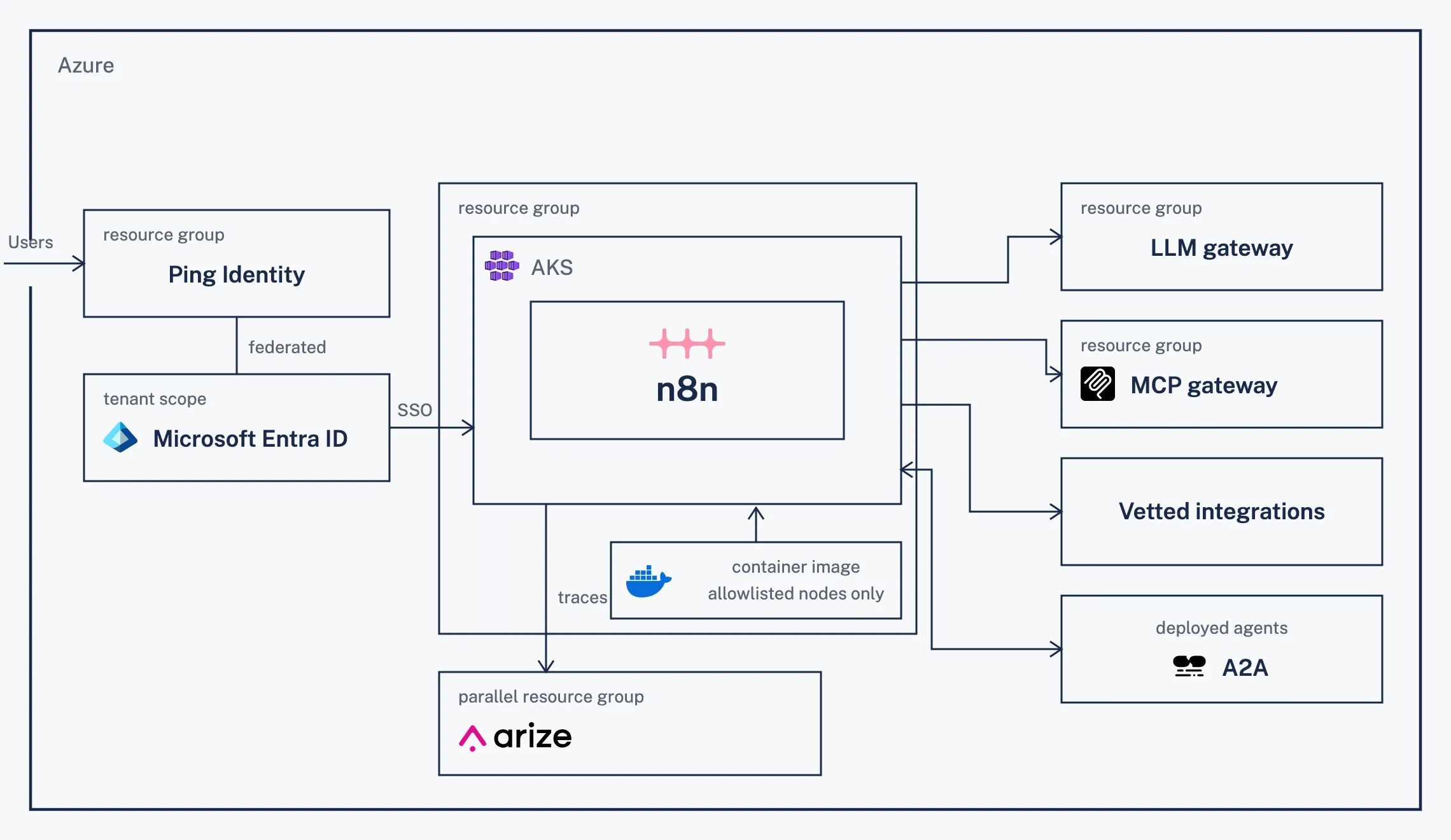
Access was handed to the company’s own identity provider, so permissions follow existing IdP groups and no separate access-control system has to be maintained inside the tool. Every model call was routed through the internal LLM gateway — for ordinary workflows and agent workflows alike, there is no other way out. Egress was walled so nothing can reach a resource outside internal IT.
The component surface was closed the same way: community nodes disabled entirely, a selected allowlist of nodes exposed to users, and each custom node baked into the Docker image, so what ships is exactly what was approved. Any further integration passes the internal vetting process before it is switched on.
Then the parts that make it operable. Observability went to Arize, with the span data rewritten
— out of the box every trace read workflow.execution -> node.execution, which tells an
engineer nothing at three in the morning. Evaluation came in two forms: offline runs through the
built-in mechanism, and LLM judges configured against the workflows marked for it.
Finally, interoperability. The platform ships no agentic-protocol support, so it was built: an A2A integration in both directions, letting agents written in the company’s own Python tooling call these workflows, and letting agent workflows call and orchestrate other deployed agents. An MCP gateway integration connected the sanctioned tool surface.
The result
Six of six pilot use cases came back with a positive review and a recommendation to invest further in the tool. Testers reported reaching the basics in under an hour — inside a thirty-minute session they were building agents, work that had previously been gated on knowing how to code.
The quieter result is the one that matters for anything agentic inside a large organisation: the set of things the platform can reach was decided in advance, by the people whose job it is to decide that, and it is enforced by the image rather than by policy documents.
Other work
Have a system shaped like this one?
Thirty minutes, no pitch deck. You describe the problem; I tell you honestly whether I’m the right person to solve it.
Book a 30-min discovery call